 0117 9381 600


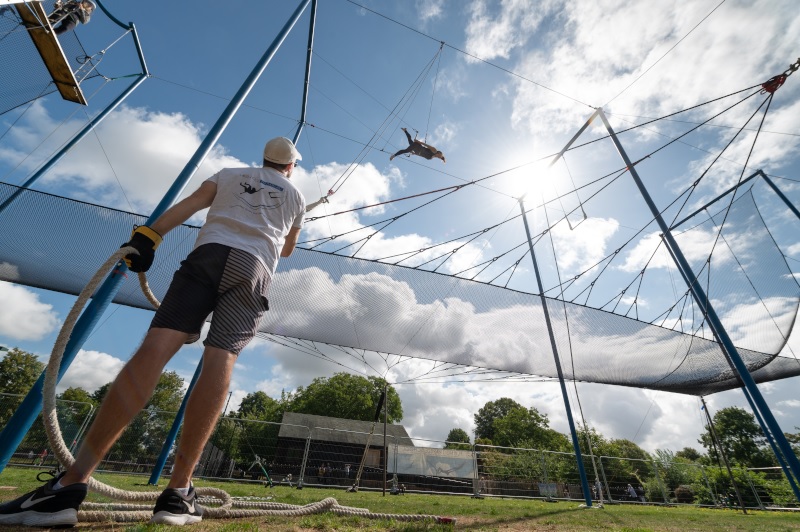
If you've ever been to the circus then you have probably seen acrobats swinging and leaping from a flying trapeze, but have you ever thought about all the work that happens beforehand to make those death-defying tricks possible?
Obviously the performers themselves have to put in a huge amount of effort to reach that point, but for each person who actually gets to bask in your applause on the night, there are several others behind the scenes who worked hard to set up that trapeze rig and ensure its stability.
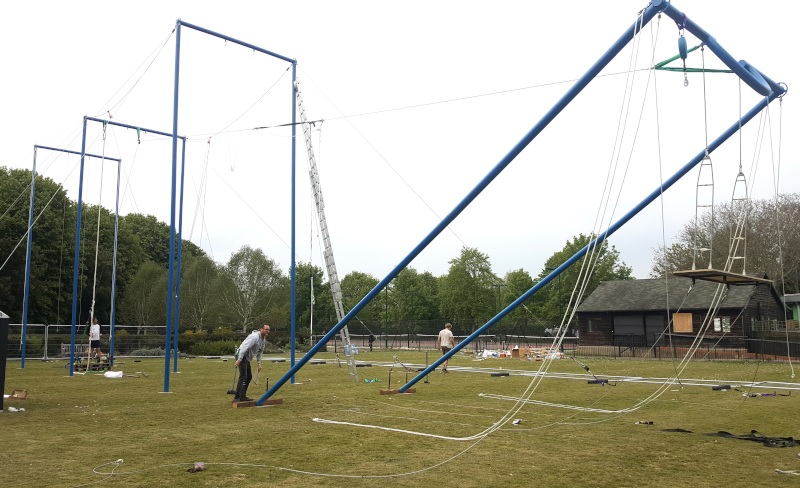
High Fly Trapeze is a flying trapeze school that operates in Oxford's Florence Park during the summer months. Since their inception in 2019, they have taught over 3 thousand people how to fly on a trapeze.
What does this have to do with us here at Safety Liftin Gear? Well, being a seasonal school, High Fly have to put up and take down their trapeze each year – a big job that takes a couple of days, half a dozen people, and a fair amount of lifting equipment.
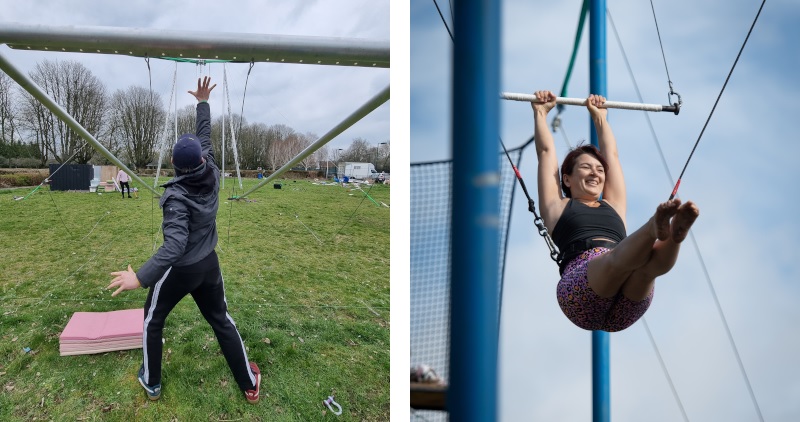
What equipment did Safety Liftin Gear supply for this job?
Rather than answering that question ourselves, we'll let High Fly Trapeze director James Long walk you through the process of setting up a flying trapeze:
There are many types of flying trapeze rig, but ours is designed for use primarily as a school rig for teaching. It is 10 metres high and is made up of steel leg sections that slot together with a crane bar over the top to form what we call a frame, of which we have four. The four frames have a combined weight of 1.45 tonnes and are guyed to the ground with a series of anchors and steel cables (whereas trapezes in circus tents tend to be rigged to and from the celling).
When people think of the flying trapeze they imagine acrobats flipping through the air, but on touring shows the actual performance only makes up a small portion of the job. The more labour-intensive part is setting up the trapeze and making sure it's safe for the performers – or in our case, for members of the public!
As a seasonal school, we thankfully only have to put up and take down the trapeze a couple of times each year, but it is no small feat. For a rig build we typically use a team of six, and it can take up to two days to get it set up just right.
Once we have marked out the location of the ground anchors and where the bases of the frames will go, we prep our lifting gear. On any build we routinely use the following (all supplied by Safety Lifitin Gear):
- Slings
- Shackles
- Carabiners
- Ladders
- Tirfors
- Fall arrests
- Ratchet straps
- Rope
- Pulleys
The first frame is built lying down on the ground. Using a combination of round slings and bow shackles, the two corners are bridled into a single point that is connected to a Tractel Tirfor T500 Wire Rope Cable Puller. The tirfor itself is connected to a series of ground anchors that keep it secure. The base of the frame is butted up against old railway sleepers that are secured by ground anchors so that, when we lift the frame, the bases don't slide.
To start the lift, we get the whole team to raise the first frame to chest height so that the tirfor can take over the lift. Once the tirfor has the weight of the frame, workers position themselves in the areas that need attention for the remainder of the lift. That means watching the ground anchors that the tirfor is connected to, watching the bases of the frames for any slide or lift, and ensuring that the frame is correctly connected to the ground anchors so that the frame cannot tip over once it's nearly vertical.
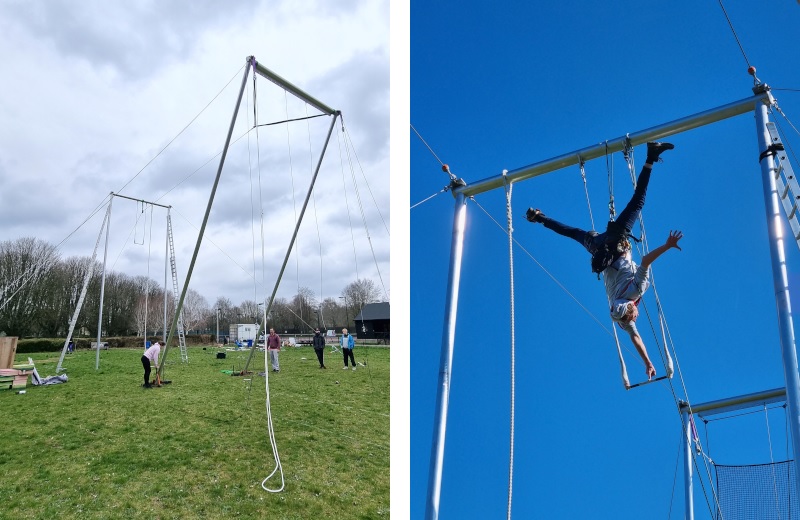
Once the first trapeze frame is up and secured using down guys, it acts as a leverage point to repeat the process for the other three frames through a pulley on a swivel without the team having to start the lift themselves.
When all four frames are up, it's time to connect the net. We pull it up using pulleys on the corners of the end frames, then apply tension by pulling the net either down and or back via a series of ratchet straps and pulley blocks.
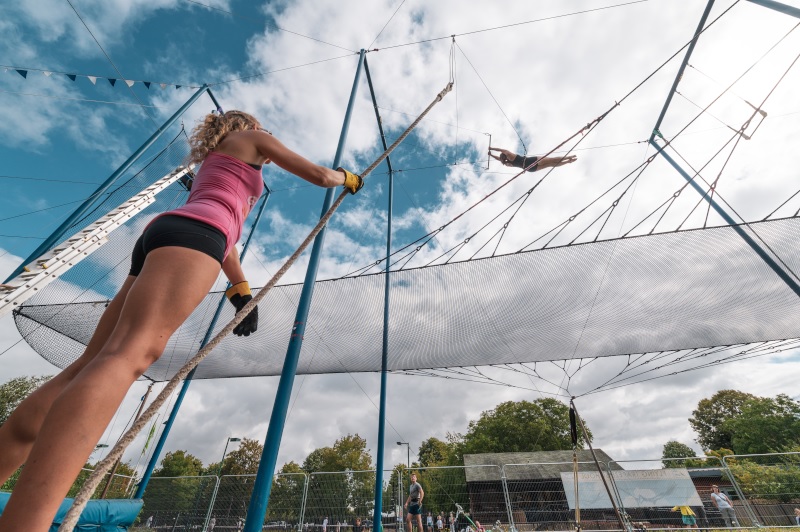
Day-to-day trapeze safety
Of course, the hard work doesn't stop once the trapeze is up. In addition to helping the initial setup to go smoothly, Safety Liftin Gear's products play a crucial role in the safe everyday running of the school. James explains:
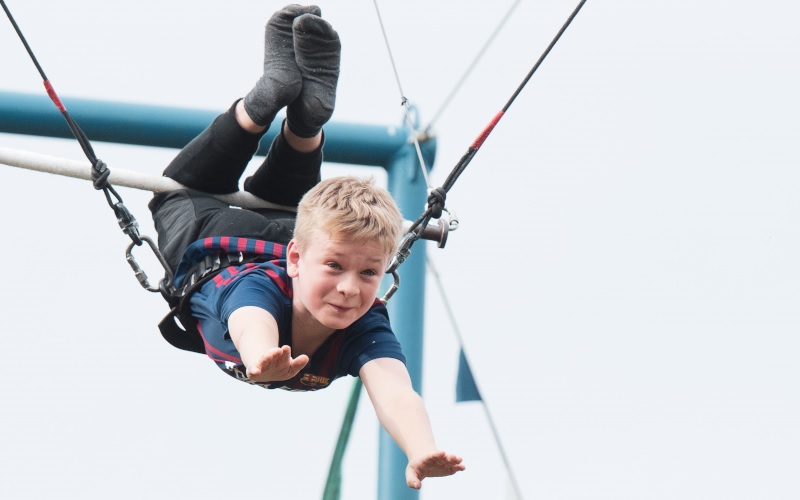
Our student safety lines system is made up of two tandem pulleys (one double pulley and one single pulley) that track the flyer forwards and backwards whilst being connected to an instructor who is on the ropes to guide the student's dismount into the net. This twin-point system also keeps them centred over the safety net.
In addition to the pulleys, we use multiple swivels in various places to account for rotation during tricks.
As you can probably tell by now, flying trapeze is more than just people in shiny leotards smiling and doing somersaults. What you don't see is all the planning, inspections, downrating and calculations of dynamic forces that are required when choosing the equipment that allows humans to swing to and from each other. Thankfully, Safety Liftin Gear cover all our needs and we highly recommend their products.
Thanks very much to James at High Fly Trapeze for this exceptionally detailed testimonial! Here at Safety Liftin Gear, we pride ourselves on our ability to provide the right piece of equipment for virtually any lifting job – hit the button below to browse our extensive product range, or feel free to contact the Safety Liftin Gear team if you need help finding the product you need.

