 0117 9381 600


When you're selecting lifting equipment for industrial operations, a solid understanding of load capacity terminology is critical for safety and regulatory compliance. Two terms you'll frequently encounter are working load limit (WLL) and safe working load (SWL). While these terms are often used interchangeably, modern safety standards have made important distinctions that every lifting equipment operator should understand.
This comprehensive guide explains what WLL and SWL mean, how these values are calculated, and the key differences between WLL, SWL, and maximum rated capacity (MRC).
WLL and SWL explained
The terms working load limit (WLL) and safe working load (SWL) both refer to the maximum weight a given piece of equipment can safely lift. For example, if a chain block hoist has a WLL or SWL of 500kg, it should not be used to lift loads that weigh more than 500kg.
The terms WLL and SWL are often used interchangeably. The Lifting Operations and Lifting Equipment Regulations 1998—better known as LOLER—favour the term 'safe working load', stating that…
"All lifting equipment, including accessories, must be clearly marked to indicate their 'safe working loads' (SWL) - the maximum load the equipment can safely lift."
However, in more recent years, WLL has replaced SWL as the preferred term in most formal usage. For instance, ISO 17096:2015 (an international standard that focuses on load lifting attachments for cranes) uses the term 'working load limit', defining this as "the maximum load the attachment is designed to lift under the conditions specified by the manufacturer".
In most cases, it doesn't really matter whether you use the term WLL or SWL because both are widely understood to mean 'the maximum load this product was designed to lift'.
That said, some people do use the two terms to differentiate between the product's maximum lifting capacity in ideal conditions and the maximum load that can be safely lifted in the present circumstances.
WLL vs SWL
Working load limit (WLL) is the maximum load that a piece of lifting equipment is designed to safely lift under optimal conditions as specified by the manufacturer. This is the standard term used in modern safety regulations and international standards. WLL is the preferred terminology in most contemporary safety standards.
Safe working load (SWL) traditionally referred to the maximum weight a piece of lifting equipment could safely handle. SWL used to be the standard term used across the industry, and it still appears in older pieces of legislation like the UK's Lifting Operations and Lifting Equipment Regulations 1998 (LOLER).
However, the term 'safe' created legal ambiguity. It implied that as long as operators stayed within the SWL, the operation would be completely safe regardless of other factors, which is not always the case. Variables such as lifting angle, dynamic loading, and weather conditions can all affect the actual safe capacity.
This is why WLL tends to be the preferred term nowadays: because it specifically refers to the maximum capacity in optimal conditions.
How WLL is calculated
WLL = MBS ÷ SF
MBS stands for minimum breaking strength. This is the minimum force at which the equipment will fail structurally.
SF stands for safety factor. This is a multiplier that provides a margin of safety.
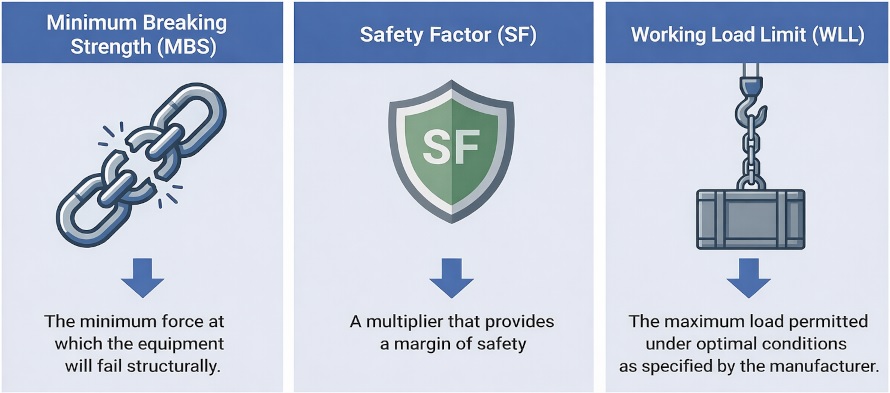
Remember, while international ISO/EN standards have moved to WLL terminology, some regulations like LOLER 1998 still reference SWL. In the UK, both terms are legally acceptable and are taken to mean the same thing. Equipment marked with either SWL or WLL is compliant.
| Term | Stands For | Current Status |
| WLL | Working Load Limit | Current standard term for accessories below the hook |
| SWL | Safe Working Load | Legacy term still used in UK LOLER; WLL preferred in modern ISO/EN standards |
| MRC | Maximum Rated Capacity | Current standard term for cranes and hoists |
Frequently asked questions
What is working load limit?
Working Load Limit (WLL) is the maximum load that lifting equipment is designed to safely lift under the specific conditions outlined by the manufacturer. It is calculated by dividing the equipment's minimum breaking strength by an appropriate safety factor.
What's the difference between SWL and WLL in UK regulations?
In UK practice, both terms mean the same thing: the maximum load equipment is designed to lift. LOLER 1998 uses 'SWL' terminology, while modern ISO and EN standards prefer 'WLL'. Both terms remain legally valid in the UK. You'll see SWL on older equipment and LOLER certificates, while newer products typically display WLL to align with international standards.
How are working load limits calculated?
WLL = Minimum Breaking Strength (MBS) ÷ Safety Factor (SF). The manufacturer determines the breaking strength through rigorous testing, then applies an appropriate safety factor (typically 4:1 to 7:1).
What is the difference between WLL and maximum rated capacity?
WLL refers to the maximum capacity of individual lifting accessories (below the hook). Maximum rated capacity (MRC) refers to the maximum load a complete lifting machine (crane/hoist) can lift in a specific configuration.
* * *
At Safety Liftin Gear, we are committed to providing our customers with top-quality lifting gear alongside all the information that's required to use the equipment safely. That's why we always display the working load limit (WLL) on our product pages.
For more information about our products and their load capacities, please don't hesitate to get in touch and a member of our team will be happy to help.

